

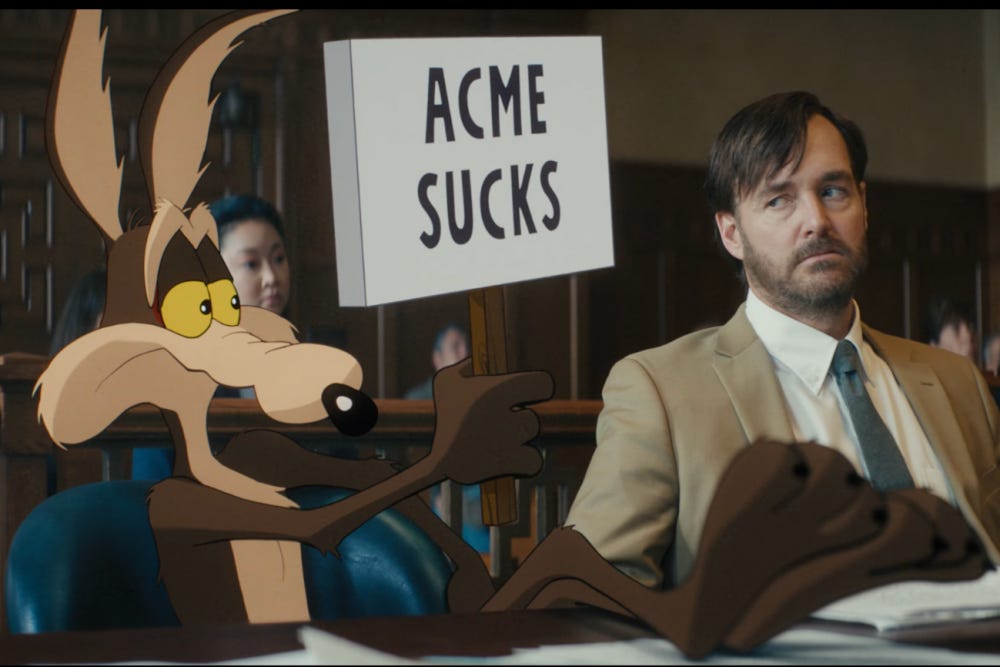
Like the archetypal Looney Tunes character, Coyote vs. Acme has bounced back against impossible odds to finally enjoy a theatrical release, some three years after it was initially completed.
Shelved by original distributor Warner Bros, ostensibly for tax reasons, director Dave Green’s film now comes to life courtesy of new distributor Ketchup Entertainment. Delightfully, it also proves to be worth the wait: a knockabout comedy cum legal drama in which Will Forte’s hapless, low-rent lawyer joins forces with the tenacious Wile E. Coyote. The reason: to expose the faulty ACME products that have made the latter’s capture of his ‘beep-beeping’ nemesis Roadrunner so impossible.
In the manner of live-action/toon classics like Who Framed Roger Rabbit, Coyote vs Acme has as much to offer the grown-ups as it does the kids. The film owes much of its buoyant energy and humour to the inventive and intricate score by composer Steven Price, Oscar-winning for Gravity and a musical chameleon whose work has ranged from Edgar Wright movies like The Running Man to acclaimed documentaries such as David Attenborough’s Oceans.
I caught up with Steven to discuss the process behind the score, its main themes and what it takes to invest real emotion into a central cartoon character so often used as a mere punchline. The full interview can be listened to below, and it’s followed by a full transcription of the conversation in this post.
Sean: Steven, I was just saying off-mic that I last spoke to you roughly 18 months ago for David Attenborough’s Oceans, for which you’ve been Emmy-nominated. So, congratulations on that. That’s fantastic news. And you kind of trailed Coyote vs Acme then. I don’t know if in mid-2025 it had been confirmed for a distribution release. That might have happened just after that conversation that we had. But I’ve never interviewed a composer before where they’ve sat with a project for so long because it had been delayed for an extended period. After all, this film has been delayed for three years; it’s now just recently received a theatrical release, which is fantastic. What has been your experience as a composer going through that journey with this film and this soundtrack?
Steven: It’s just been a very extended roller coaster thing really. When we finished the film, we were all super proud of it, and it was always this nagging thing for me. It’s like, when’s our release date? Because we had a release date, but then we lost it to Barbie at one point. And then, you’re just waiting for them to announce it. And the longer they didn’t announce it, the more you’d be like, what’s going on here then? And I remember texting Dave Green, the director, and going, have you heard anything? And just sort of, now and then, checking in with him just to see what he knew.
And then one day you get the call saying, oh, they’ve decided on their release strategy, and it’s to not release it. So that was horrendous and depressing, and then you start to question kind of, God, did we really screw up? Was it terrible? Did we just believe what we were doing and didn’t listen to other people? We always were aware it tested really well. So that was a strange period where everyone went a little bit kind of, this is sad. Then obviously, a lot of people stood up for us and supported the film, and that was amazing. So that was a big high in that.
But then you had the lows afterwards because then Warner Brothers said, oh, you can shop it to other people, but they didn’t really have much intention of doing it. So people were putting offers in and, you know, it wasn’t necessarily getting responded to. So I thought it was dead at that point. But there was- I’ve heard Will Forte and Dave Green talking about it - there was always a bit of me that was like, this is going to be seen at some point. I mean, there were weird wordings in some of the articles at the time about deletion. And you’re like, they’re not actually going to delete it, are they going to?
Sean: They’re not going to do a Batgirl on us, surely?
Steven: But you just didn’t know. So, so yeah, when we did get the news that it was coming out, it was fantastic. And it’s just been a long wait since then. I think it was about a year ago that we heard that it was coming out. And then it was just waiting for the right date.
Sean: So at what point had you recorded the score? Did you record that in 2023?
Steven: It was all finished. The film was finished. So we’d recorded and mixed the score. The film mix was done, all of the animation was done, it was complete. The film that is out in theatres now is identical to the film that was shown in the funeral screening the day after it was cancelled. Nothing has changed. I think there’s a card at the end now which thanks people for their support. That’s the only addition that was made. So yeah, the film was absolutely 100 % finished. Yeah.
Sean: This is a relatively unusual circumstance with a delayed film. I suppose by asking you these questions, I’m asking you to throw it back probably about four or five years. But how did you get involved in the film? Was it Dave Green that got you involved in it?
Steven: Yeah, I think he was he was looking for someone to work with on it. And I was on a list of people, you know, as tends to be the case. And they sent me all the material. So I read the script. I was familiar with the original 1990 article, Ian Fraser, the New Yorker article, which sort of proposed this Coyote versus Acme court case plan. And yeah, I loved the script because the script has felt like all the smart ideas in that article just expanded into something really funny and smart and interesting. And then, yeah, I just went in to meet them. So they had a cutting room in London, and I saw some early cuts of a couple of sequences, and it was just really clear that they totally- everything in your mind about how this could be done really well, they were already doing it.
And so you just get excited, and then you could have a chat about how music could be in a film that took these characters and put them into a different kind of place. So it was a nice one to get when you got the call that you were doing it. It was like, oh, fantastic. This is a huge deal for me. I love doing animation anyway, but with characters you’ve grown up with like this, it’s just fantastic.
Sean: Yeah, because separately, you’ve done a lot of live-action movies, but you have done animated movies as well, as you said, so this is your chance to hybridize those two approaches. I mean, are the approaches to those respective genres different? And is it a challenge to put them together?
Steven: Well, think this one gave you the best of all worlds, really, because you got to do, you know, that more old school style animated writing where you know busy, busy chase sequences with every moment, and every movement on screen is captured in the music and you’re really colourful with it and you use the orchestra in different ways and you kind of just get to get really stuck into those techniques. But then it’s also a courtroom drama, so you’ve got to kind of do that more emotional side, I suppose. But what was fun was kind of setting up all of these Looney Tunes kind of feeling things but using the same themes in different ways and sort of transforming them into what’s hopefully quite a sort of emotive score by the end.
Sean: Because you mentioned the classic cartoon approach. I suppose Carl Stalling would be the classic approach, like Mickey Mouse, very mimetic, a lot of different key points. What would you say his influence on this particular genre of music has been?
Steven: Well, he’s just like this towering giant, I think, when it comes to this stuff. You watch those cartoons and the original films from, you know, way back when. And they’re amazing, you know, and how they did it. They didn’t have the technology we have now. It’s kind of full of character. That’s what I loved about it. It always felt absolutely full of character and alive. And you could feel the enthusiasm of everyone in the room. And it just, yeah, what we tried to capture really, I think, is that sense of joy of this.
We had the big screen up in the studio so all of the musicians could see what was happening. And they all grew up with these characters as well. So there was just a sense in the room of like, this is really good fun. And I think you can feel that in the film.
Sean: Oh, yeah, you can totally hear it in the score as well. So was that your collaboration with Dave Green? Was that the principle, that this has got to be joyful and colourful and fun?
Steven: Yeah, we just wanted it to... I mean, he describes it brilliantly in the following way: if this is the Looney Tunes Avengers, then this is like the Iron Man movie, because this is where you focus in on a single character. It kind of extracts a character out of, you know, a figure of fun really in the previous usage. He’s usually just this hapless, sort of, continually failing character. And finally you start to look at him. So yeah, we just got stuck into honoring all the kind of, you know, there were moments that are really Looney Tunes-feeling things. And then there are other moments that, that, you know, hopefully dig a little, little deeper, but retain that sense of character. So Dave and I worked really closely together, and I would send him a lot of music, and he gave me great notes. He’s a really detailed thinker, so he kind of gives you very, very sort of analytical, helpful notes about, like oh we could try this a couple of frames later, and I think it might help the comedy or whatever. So a lot of back and forth.
Sean: So given this is such a technically complicated film, we often hear about films with a lot of different elements about the notion of the locked cut and whether the cut is changing. Like, at the point that you were scoring this, was it locked? Did you have to accommodate maybe bits of animation that were being filled in later on, or was it all done?
Steven: I think by the time we recorded it was very, very close to being locked. There might be a couple of little tweaks that we had to do down the line, but yeah, the animation had to be locked in so that they could finish it.
I think in that respect, I was lucky because a lot of those really sort of frantic action sequences, I think if a hole was cut in one of those, you’d really struggle to ever get that feeling back. And like I say, we really were playing with frames. It’s the difference between hitting something exactly on the frame and hitting it fractionally before or after seemed to change the whole nature of the comedy in it. It was a lot, yeah, it would have been awful if the picture changed a lot after we recorded on this one.
Sean: Yeah, because as you said earlier, when talking about cartoon scoring, it’s infinitesimal timing, isn’t it? Probably more so than a lot of other genres, like the exactitude of the beats that you’ve got to hit. That must be very challenging to be able to do that.
Steven: It’s just satisfying when it comes together. It’s just great, you know, when you feel that the music is really supporting everything and that you feel people smiling as they watch it. I’ve got some lovely photos of the sessions of people just looking at the screen and smiling because it just felt like we were watching a movie, you know, so that was satisfying moments.
Sean: So the sessions – were they conducted at Abbey Road?
Steven: Yeah, we were in Abbey Road Studio One for the majority of this. So we did all the orchestra and choir there, and then lots of the smaller stuff like, you know, banjos and that sort of thing were done in my studio.
Sean: Excellent. From my point of view, having heard the score, I could discern, and you can correct me on this, I could discern two major themes, one of which seems to be the kind of conspiratorial, vaguely noirish ACME theme and the other being the beep beep Coyote/Roadrunner theme, which we can get onto in a minute. Is that broadly how the score breaks down: these two identities kind of circling each other?
Steven: Those are the majors. Yeah, the sort of the Wiley was the main thing and then the ACME Corporation overseeing everything. There’s this other idea for the lawyer firm, the Avery figure, and there’s, you know, Bugs Bunny has got his own little thing and stuff like that. So there are these counter things within it. But those two, yeah, those two themes are used a lot.
Sean: So if we look at the ACME theme first, there are elements of Western in there as well. You mentioned the use of like banjo because of where Wiley Coyote and Roadrunner come from. There are obviously elements of Western in the music as well, which is really witty and really funny. But the notion of the film is that ACME are actually quite sinister and they’ve been inflicting all these products upon Wile E. Coyote that aren’t working. So did that notion of ACME being kind of Machiavellian like underpin that particular theme?
Steven: Yeah, I mean, it’s how that theme started. There were some corporate videos made for ACME and of all the products that they make. And it was, you know, all very shiny. There was this quality of ACME being, you know, just one of those faceless, massive corporations. And it had to sort of be able to be used in lots of different ways. It could be used really slickly. It could be used in a really sort of sinister fashion. It could kind of be stretched out, you know, and Buddy Crane, the evil lawyer of ACME, it’s used kind of for him quite a lot when he’s doing his speeches. It can be made quite ‘Americanery’ in places.
A lot of it was kind of fragments in Wiley’s theme as well. It’s like a motif, really. The theory being that, for Wile E., everything is these short impulses. You know, all he thinks about is this obsession of wanting to catch the Road Runner. And he starts, and he gets super excited, and he fails, and he starts again in a different key basically. And then the whole thing was like that. So lots of different kind of like, here we go, here we go. Oh no, and we crash into a brick wall. So it was all sort of short, short, sharp kind of figures that could then be played against each other in different ways.
Sean: That’s a very interesting challenge, isn’t it? Because in the cartoon sense, you’re dealing with kind of short-term impact, but you’re also building a long-term narrative because this is a feature film. So I imagine that presented its own share of interesting challenges, didn’t it?
Steven: And that’s my favourite thing about films really. You can set these ideas up and then almost by the end of a film, you’re kind of just a spectator as you see them working against each other and like all these things combine in different ways. Sometimes, I write themes that are so different you can’t imagine how you combine them in the end, and they always magically find a way to do it. And this one, yeah by the end of it you were kind of blending between all these ideas as it became a big rousing courtroom finale, you know.
We’ve got to get to the ‘beep beep’ coral arrangement, which I remember you teased when I interviewed you previously about Oceans. You said that you’d done this and I was really intrigued to hear how that sounded – now I’ve heard it, and it’s fantastic. So was that all the use of the Road Runner noise and adopting it for choral purposes? Was it always the bedrock of the score? Was that always in contention to be in there?
Steven: It was an idea I had quite early, but it was an impossible idea to explain to people. So I kept sort of saying, oh, I’m going to do that as well. And people just looked at me a bit blankly because it’s sort of, it’s impossible to- you can’t demo it, you know; you can’t get a choir for a day. So yeah, the thought to me was that because Wiley is so obsessed with the Road Runner, like the sound of the Road Runner running away from him would haunt his dreams basically. So it was this, and I thought that like the funniest possible version of that to me would be if it was quite operatically choral and it was just echoing around in his head all day long – sometimes it’s optimistic, sometimes it’s almost mocking him and you know.
So, that was the idea. And then I kept kind of, you know, saying, I’m going to do the ‘Meep Meep’ choir in this. And then we finally got to the sessions. And we had a little thing that came up online the other week where we had to decide if it was ‘beep’ or ‘meep’. Because I’ve always maintained it’s ‘meep’ because it sounds like it, but it’s always written ‘beep’. So various people were like, oh, it’s got to be ‘beep’. So we worked that out. And then it was just really good fun to have these amazingly talented, highly trained singers just ‘beeping’ their way through the day.
‘I think when you’re dealing with these sort of characters, and they’re so emotive with their expressions, and how they physically move, you kind of have that license to go with them and to paint the colours with them. It all becomes part of that feeling’ - Steven Price
Sean: So you’re there in the session, you’ve got these amazing choral singers, you present this idea to them for the first time. What was their initial reaction when you said, ‘This is what we’re going to do today’?
Steven: They were game for everything. It was great. They just, I mean, again, we’re showing them the picture. They know that this is a Looney Tunes film. Everyone’s kind of excited when these sort of things come up. And it’s, yeah, they were so enthusiastic, and they gave me so much variety and threw themselves into it. It was just one of those really lovely sessions.
Sean: Because ‘beep beep’, ‘meep meep’, however you say it, it is a quick-fire signifier. It kind of comes and goes very, very quickly. So I imagine you have to be quite judicious and choose your moments quite carefully in terms of how to create a signifier in the score.
Steven: Exactly. And you sort of tried to incorporate it in the cues in ways that made it sort of worth having. You know, you didn’t want to just splash it all over the score, and it feels sort of over the top. You want to find ways for it to be incorporated. There’s a scene in a cave halfway through the film where there’s a little textual sort of noise, of a shivery sort of noise. And that’s just them all whispering the word ‘meep’ all the way through that thing. Again, it’s like little sort of echoes in the distance. So we’d always try and find ways.
The most extreme version was a rendition of the 1812 Overture, and we got them to do that. That was a very last-minute idea that I had, and so it was one of those, oh, can we get this done in time?
Sean: And also the sound effects that the choir is doing, it kind of appears to go both full tone and semi-tone regularly. I’m assuming if it goes full tone up, that must be a particular moment of revelation that you’re addressing in the film, yeah?
Steven: Yeah, I mean, the music was already there, and it was kind of a way to think about how we can incorporate them in a way that just expands the message of the piece that’s playing. So, yeah, it was a little bit of playing around on the day with that sort of stuff. But it was, yeah, there’s a there was a lot of laughter in the control room that day.
Sean: Well, it’s the sound of an entire childhood. It’s the sound of my childhood. Because as with most people, I grew up watching Looney Tunes and I just need to hear that. And I know exactly what character that is signifying. What you’ve done with that noise is just wonderful. And the way it becomes a cathartic element at the end of the movie, I’m assuming that was the intention as well.
Steven: Yeah, with the whole score, it was just planting these ideas and just taking that character from being this kind of hapless but determined creature who just fails all the time. You realise the relationship that’s been built up over decades with those two as well. My dream was always that we could get to the end of the film and have made a Looney Tunes movie that moved people because that is such an unlikely idea really. That’s been one of the great things about the film coming out this last couple of weeks; a lot of people have said, ‘I was surprised it was a bit emotional at the end’. That’s been nice that we got there.
Sean: Yeah, the bond between Will Forte and Wiley is poignant. Like you do care about the bond that they share.
Steven: Yeah, and the underdog thing of it all, you know, they’re both, yeah, they sort of, they sort each other out through the adventure, really.
Sean: And you mentioned the use of the 1812 Overture there. Was that, I mean, I might be wrong in thinking, has that fallen out of copyright? And was that like a relatively easy thing to kind of manipulate in that sense?
Steven: I mean, the composition certainly, yeah, that’s, that’s, that’s long out, and we recorded everything, but it was, was another thing that it felt like, you know, a Looney Tunes film needed, you know, they did an awful lot of quoting of classical repertoire and those original works and we wanted to do that at least once somewhere in ours. And so, so yeah, this, it just felt like a very funny solution to that. And yeah, I mean, we did some horrendous edits to it. If anyone truly loves the piece, they would be mortally offended, I think, by what we had to do to make it work for the picture. But hopefully it’s acceptable.
Sean: It’s a very fortunate orchestra; they got to perform your score, but they also got to perform Tchaikovsky, albeit in a satirical rendition.
Steven: The most insane tempo changes that we ever put in front of them. But they were just, know, again, they just listened to it once, oh yeah, yeah, fine. And then they got on and played it perfectly. Got it.
Sean: Yeah. Well, that’s, suppose that’s the extraordinary thing about session musicians. They don’t have time to learn this stuff. I mean, they might’ve known 1812 already, but in terms of your score, I’m assuming they come in, they learn it literally almost not quite sight-reading, I suppose, but they have to adapt very quickly.
Steven: Oh yeah. Yeah, their first run through, you know, will be very, very good. They are brilliant players, and we try and put as much detail in the scores as possible too to help that process. We put all the bowing instructions and things like that, just so we don’t have to stop and discuss any of those things. We can just hear the music, and by four or five takes in, you’re often quite close to the master recording, which is incredible when you think about it.
Sean: How many players, orchestral players, did you have on this score then?
Steven: I think over strings, woodwind, brass and percussion, there were around 70 orchestral players. And then the choir, I believe, was 40 voices. And then obviously you’ve got the more soloistic things as well, all the plucky stringy things.
Sean: So Dave Green and all other filmmakers, were they present at the recording sessions?
Steven: Dave was there, and Carsten Kurpanek, our editor, was there with his daughter, who was super young when all this happened and actually like nine or something. And our producer, Christopher DeFaria, was there. So yeah, we had various sort of visits over that time. So yeah, it was a lovely few days.
Sean: I imagine there was a lot of goodwill in that room, bearing in mind the heritage with which you’re working, right?
Steven: Yeah, absolutely. And for me, I’d done a few animation films before, but I’d never got to record one in London. And I’d always wanted to. And so this one was the first time I got to do this sort of music in London, you know, and that was lovely because it was, you know, obviously I’ve worked most with the players in London. So it was great to do this sort of score with them as well.
Sreven: There is a phrase that’s often applied to animated scores, which is ‘Mickey Mousing’, which can be seen as derogatory or maybe it’s just descriptive. I wondered what you thought of that. Maybe it’s just another way of saying mimetic or with a lot of energy or something to take it back to Carl Stalling.
Steven: Perhaps. I mean, there are certainly parts of the score where it’s super, super Mickey Mousey. It’s following every kind of moment on the screen, but intentionally so. On this one, you’ve got to do that in some places, but in other places play the images differently, you know, be more supportive of things and less sort of intensely connected to the picture. I think when you’re dealing with these sort of characters, and they’re so emotive with their expressions, and how they physically move, you kind of have that license to go with them and to paint the colours with them. It all becomes part of that feeling, I think.
Sean: I mean, you really do get to let rip with some huge action sequences as well. The freeway chase sequence, that must be so much fun to be able to do that, I imagine.
Steven: Well, yeah, because you’ve got amazing visuals you’ve never seen before. And there’s one point at which someone picks the tarmac of the road up and kind of, and that’s an image that I’d never worked with before. Immediately you’re starting to… it gives you different ideas and gives you different ways to tackle it. And that’s great if something makes you smile and think in a different way about writing an action sequence. That’s a bonus.
Sean: Yeah. There was one of the bits in the film that really made me laugh. And I wanted to ask what your involvement was in the ‘beep beep’ cover of DJ Shadow, which kind of came out of nowhere, which really made me laugh. I mean, there were a couple of kids in the screening room; they probably didn’t get that, but I thought that was absolutely hilarious, because I love that song.
Steven: It felt great. And then we obviously had a problem with the lyric. And so yeah, the idea – I think I pitched the idea of it. And then Bradley Farmer, who’s the music editor on it, had endless fun putting the meeps in places basically, and we would we would go away, you know, if we put two meeps here and one meep here.
My daughter saw the film last weekend, and that was the first thing she said that that was her favourite bit.
Sean: And has DJ Shadow himself reached out? Has he said anything about it?
Steven: Not to me personally, but I know he had to hear it for us to use the track; he’s definitely heard it. Yeah, I did do a track with him a few years ago, so I’ve kept thinking of reaching out, but I’ve not quite had the nerve yet.
Sean: Excellent. Well, it’s 2026’s greatest resurrection story, both this film and the score that’s attached to it. It’s wonderful that we’ve got both the film and the score now. Stephen, I wondered, as a way of rounding off, what do you hope people take away from the movie and indeed your score?
Steven: I think the whole Coyote story has been this incredible – there’s gotta be a documentary or something about the making of this film at some point because it’s just this amazing redemption arc. And it’s so reflective of the film itself. The film’s all about this underdog, you know, who’s been slightly oppressed by a big corporation. And, you know, the film has kind of reflected that in the way it’s come out as well. Hopefully, it’s, you know, it took a lot of support from people not giving up for it to come out. And I think the fact that it has come out and people have got the opportunity to see it and hopefully a lot of people are enjoying it. That’s great. You know, and it just shows that we can do stuff, you know, we can, we can make stuff happen. Yeah, it’s been, overall, a really positive experience.
Sean: I never thought about it in that way. Yeah, the journey of the film is kind of analogous with what Wiley himself got. Yeah, that’s true. Yeah, yeah. It’s like everything rises, everything rises to the top.
Steven: And yeah, I mean, it’s a tale of resilience, basically, like Wiley is incredibly resourceful and resilient. And so were the people who kept behind the film and kept pushing for it to come out and you know, managed to take an absolutely lost situation into what we’ve got now, which is a release around the world.
Sean: We should credit Ketchup Entertainment, who picked it up and who revived the whole thing.
Steven: Absolutely. It took a big swing. And yeah, incredibly grateful to them because we were lost. They’ve made all of this happen. And I was looking at the artwork for the vinyl edition of the album the other day, and we could never have dreamt that would have happened. So, now, all of this is very positive.
Sean: So to sum up then, so where, where can people find the score? You mentioned the vinyl there; where can people purchase it?
Steven: Yeah, so at the moment it’s streaming, but the album itself is available for pre-orders. IM8BIT is the label that’s putting it out, and they’ve done this incredible job with the artwork, and it’s available in a few different editions, but there’s one limited edition which comes in a legal document. The whole album is put into a legal document, and every bit of the artwork kind of reflects the story in some way, so yeah, I love it when that level of effort goes into something like that. So that’s all for pre-order now, and I think it’ll be out sometime later in the year, probably November-ish out in full.
Sean: Fantastic. Well, that’s the soundtrack. Coyote vs. Acme is on release now, finally, after years of waiting. And Steven, your score elevated the emotion and the humour of the film brilliantly. So thanks for giving up your time to talk. It’s been really, really great to see that the music is finally out there for people to enjoy. So thank you.
Steven: Thank you very much indeed.
Coyote vs Acme is on release now in the UK via Altitude and Ketchup Entertainment. The score is currently available to stream via Watertower Music.